
Creative, fascinating and full of interesting little tidbits, "Human-Cetacean Relations" would be best viewed as a PDF to retain its formatting, footnotes and references - check it out here!
A copy without footnotes and references is available on this page.
– Tonga, 2049 –
The Doctorate Isles
When asked which nations take their PhD. scholarship most seriously, few people would venture a guess that Tonga had been closely keeping tabs on its academic attainment for decades.
One of those Tongans was Tofa’s mom, who unflinchingly raised the reality of her eldest child’s enrolment gap nearly every time they had a conversation. Having met the eclectic and charming Rafael Bauer at the start of an undergraduate career, Lesieli didn’t let her relationship interrupt her first love – studying, which led to a steady, unbroken path through postdoctoral fellowships – eventually resulting in a tenured position in Medical Anthropology. Both in stature and demeanour, Tofa’s mother was a force to behold. Tofa’s dad, Rafael, was an American of much more indeterminate qualities; an electrical technician alongside his wife at University of California, Berkeley, he was a lifelong gearhead who never quite gave up the rock club sound tech roots of his youth. Rafael was a uniquely West Coast mix of pre-United States Californian, Bay area railroad-era immigrant Chinese, and late 20th century Silicon Valley surf nerd, who despite his own parents’ cultural pedigree had always felt as though he were moving between worlds, even when he couldn’t manage to be any more deeply at home. This was a sentiment Tofa had always shared, but despite a temperamental affinity with their father, they found themselves growing into the spitting image of their mother.
So as Tofa stared at the holo-tablet, they were confronted by a miniature version of themselves, twenty-five years on, in an alternate, hypothetical world where Tofa may have embraced a life of both femininity and pedantry. Tofa braced themselves, eyes pre-emptively glazing over slightly, as their mother laid in, yet again… “Why won’t you just pick a lane and stay the course, you know? See something through to the end?” On their periodic video calls, Dr. Lokotui – having kept her maiden name for the sake of her publication record – always ended up asking some form of the same question. It never failed to trigger Tofa’s ire.
“Med school is literally the only thing I’ve walked away from, and that’s because I didn’t even start,” they reminded their mother in persistent exasperation. “I have finished four albums, and for each and every one, I have toured for at least a year, always to the end.” In that process, Tofa noted, they had managed to build enough of a persona to dispense with the necessary attachment of a surname entirely, successfully avoiding the uncomfortable explanation of preferential nomenclature between their parents. Tofa knew their mother reserved a uniquely complicated form of resentment for her eldest child, and they spent concerted effort trying not to actively exacerbate this reaction, which they seemed to elicit simply by being themselves. Their younger brother, Tanginoa, had carved a much cleaner path to adoration in their mother’s books; playing rugby through college on the way to a sports medicine residency. The cumulative anxiety of navigating the conversation now had Tofa pacing with a purpose, weightily padding the deck of their beachside three-bedroom bungalow, overlooking Monterey Bay. Irate, they snidely remarked, “…and I don’t need to pick a lane when I go swimming. I’ve got the whole ocean to splash around in, Doctor Mom.”
“Si'i lile, Tofa…” Lesieli sighed in a combination of consternation and resignation, years beyond rising to active irritation at Tofa’s sarcastically applied epithet of respect. Tofa, in turn, was endlessly frustrated by the fundamentally uptight approach toward life their mother consistently decided to apply. “I’ve got to get back to grading, but here – talk to your father…” she said, unceremoniously passing the holo-tablet over to Tofa’s dad, Rafael.
Growing up, Tofa often wondered how the most easy-going guy in California had ended up with—possibly—the most tenacious woman ever to make her way out of Tonga. He had drolly explained one night when Tofa was headlining one of the 90th anniversary shows at the Fillmore Auditorium, “You know, I’ve never had to make a decision I didn’t feel was worth the trouble of thinking about.”
He had admitted this while they were tucked away in the green room, leaning forward from the overstuffed, formerly vibrant yellow couch, tour-stained and wine-mottled. Fidgeting quietly against the Piñatex upholstery, he paused to sip a Pacifico loaded with lime before he’d continued, “Your mother isn’t wrong often…so I let her make the waves and just ride them all the way to shore.” He pointed the mouth of his beer bottle solemnly, slowly, in Tofa’s direction. Despite the flurry of activity and noise emanating from all directions, on-stage and off, as the festival wore on, Rafael managed to manufacture a moment of connection, encapsulated in this glimpse into his marriage to Tofa’s mother, “Don’t tell her that – if she ever realizes how easy all her empowerment has made things, she’ll start giving me extra homework.”
Tofa had laughed uproariously at hearing this then, five years back. There wasn’t a problem Dr. Lokotui didn’t think could be solved with more studying. Now, seeing their dad again, Tofa suddenly felt a smile stretching across their face. “Hey, pops! What’s new?”
“Oh, steady as she goes over here, Tof’. Looks like good weather down your way. It’s been a gnarly winter - how’s the surf been down the coast?” Rafael asked, peering around the miniature holo-view on the tablet, trying to get a glimpse of the sea. Tofa realigned themselves to show a view of the roaring, rolling January waves.
“Heavy hitters – I haven’t gone out since Sunday when the swells at Asilomar were more my size. I tried out the new suit, though, and I think the CetaceaSkin team is on to something with these new fibre layers. I could’ve stayed in the water all day if I hadn’t been getting thrashed. Can’t spend too much time floating around – tryna get busy sorting out samples for the new single,” Tofa explained, happy to have a receptive audience with shared interests in their father.
“I don’t know about those drysuits – half the fun of spending time in the ocean is getting wet! But tell me more about this song. Is there anything I can hear yet?” their father asked. “Which species are you putting up front in the mix on this one?"
“I haven’t broken down all the logs yet, but based upon what I spotted, I’ve got some new clips from the Manuma'a, Lafu, Hengehenga, and I finally got a good take of the Malau to include,” Tofa rattled off the local birds they’d captured on record. The Malau was a point of pride, as they hadn’t seen one since they were twelve, and despite improved conservation efforts, it remained a vulnerable species.
Since having the opportunity to go on vacation throughout the entirety of their childhood was relegated to the few visits when their mother hauled Tofa along with their little brother back to Nuku’alofa and out to ‘Eua to see their extended family, Tofa found these days of calm gave them the opportunity to both listen both closely and broadly. As they learned how their family extended across the islands, Tofa also learned every layer of life that flitted through the ocean air. Summer break in the United States was always the thick of Tongan “winter,” so apart from the few weeks of term break when their cousins were free to roam with them, they spent a lot of time along the shore, watching –hearing–seabirds. From the second visit onward, once they were old enough to handle their own recording device, that meant they had an opportunity to put everything on-file for later listening and editing. Unlike many bird spotters, they were less interested in snapping photos, instead tuning in tightly on the sounds each species would make as they walked along the sand.
It was always stunning to them how differently the same ocean could strike an impression on a person, all because of what was happening on land. They became obsessed with sensorial experience of the intertidal zone, discovering how sound sped up beneath the waves. It was here they first heard the song beneath the sea. Wading out, head dipping beneath the waves, the humpbacks hailed the young musician. All Tofa wanted was to get closer, and better know the source of that sound.
“How is that underwater rig you’ve been working on coming along?” Tofa’s father asked, bringing their reflections upon the deep back to the present.
“So far, so good. Tweaking the input parameters to ensure it can handle the decibel thresholds, but the octave dropper on the output is working just fine. It should be ready for testing soon. We’ve got until the end of the season for sea trials before the holo-band. I think we’ll finally be able to provide some level of justice in truly hearing what they’ve been singing to us all these years,” Tofa explained, partially in an effort to convince themselves of the value in their long-running effort toward coordinated antiphony, lining out parts for their friends of the deep to commune upon.
Rafael smiled proudly, with a shake of his head, “You’ve definitely got your mother’s intellect, Tofa.”
“I don’t see why they can’t make a dissertation out of it!” Dr. Lokotui called the other room, still clearly keeping an ear tuned in to Tofa’s conversation.
Diving Decibels Deep
Six Months later
The booming enormity of the waves of pressure across the ocean as the Earth birthed another island into the waters of Tonga were disorienting to every sense. Feeling reality shudder and shift around you, realizing the atmosphere, the sea – the planet itself can burble and burp, and rattle humans to their core or wipe them from the map with only a slight shift of its crust – it instills a sense of geological humility in a person.
Perhaps this was the reason Tofa had been so vociferously opposed to the various seismic charges and sonar tests perpetrated by the navies of Pacific Rim nations over the course of human history. They knew how waves in every form could be monumentally catastrophic upon unsuspecting populations. More than most of the world, Tonga had cultivated an affinity for marine mammals, with non-trivial portion of the tourism economy tied to the seasonal migration of humpback whales, and increasingly close attention to dolphins residing within the expanded marine protected areas of the country. This interest in sound had honed itself from a precocious curiosity into a unilaterally focused passion over the course of their childhood, and now Tofa finally had a means of sharing those sentiments with the perennial subjects of their attention.
Their years of devouring all the emerging research, when accompanied with a dedicated interest in music theory – and unfettered access to a wide range of remaining paywalled journals through good ol’ Dr. Mom’s home office accounts – left Tofa uniquely positioned to explore the coastal waters of ‘Eua, experienced through a filter of their own design. Now, as a child of Tonga who had endeavoured understand their ancestral home as a shared space, Tofa had a platform to offer the world an invitation to a symphony performed by an otherwise inscrutable chorus. Tofa had constructed a seat along the Humpback Highway, not on the front row, but in the orchestra pit, itself. With the Strat-Stat coverage providing a relay point overhead to feed the signal out, it was Tofa’s turn to benefit from performing behind a paywall. Project Ceti was happy to hear over forty thousand people had pledged support for this holo-band broadcast, and the audience continued to swell online now that word was out Tofa was finally underwater.
It had taken over six months from the time Tofa had commissioned the design to get all the pieces in place for their new drysuit, but it was working better than they’d expected. While the tech for long-duration SCUBA operations had never been employed in this manner to-date, and with a comms-enabled IDM, Tofa was most excited about the two-way Soundfish system they’d been able to pull together with the help of a few submarine engineering colleagues and audio technician friends. Taken independently, any element of the Soundfish design might not seem new or innovative, but when daisy-chained in the manner Tofa intended, they now held the means of embedding themselves – or any operator – within the social life of a pod on its regular migrations. With the prototype school of Soundfish numbering eight in total, Tofa had prepared to deliver an expansive soundscape rendered remotely in immersive surround – piped through speakers the world over – to give their audience a glimpse into the role they had established amongst the whales.
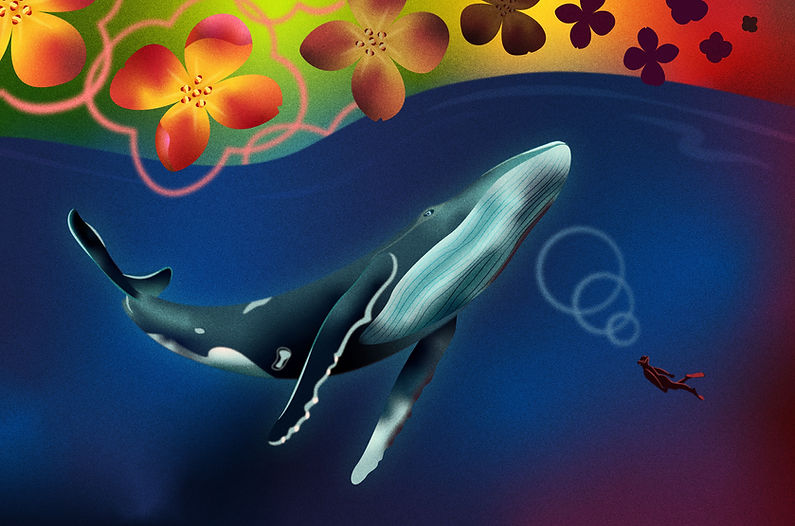
This culmination of years of applied research into whale behaviour and increasingly documented language structure led them back to Tonga, where Tofa now floated, suspended ten meters below the surface of the ocean off the coast of ‘Eua. The soft, deep wail through their headphones had presaged the arrival of Bomp, the Humpback whale they’d become acquainted with over successive years in the water. Moments later, the call of Bomp’s companion, Wahaloo, followed, and Tofa was overjoyed. The audio was coming through as clear as they could have hoped. The interface had yet to be fully tested, as the polyphonic drop unit technically worked, but whether it carried rhetorical value to its cetacean recipients was yet to be determined. There was every reason to wonder if the Soundfish could keep up with the pods they were designed to accompany after this ceremonial introduction. The saildrone, glider, and satellite monitoring all had the benefit of being able to keep pace with the whales, but none were able to embed themselves amongst the pod communities. Tofa hoped the Soundfish would provide the appropriate avatar for human immersion in the society of their giant friends.
As the sound began to swell in their headphones, Tofa beamed in response; there were three other whales out there, and from the higher frequency joining the others, at least one calf among them. Tofa had been studying the records collected each year, and had steadily incorporated each season’s shifting songs into their repertoire. The culmination of their whole endeavour was now at-hand – Tofa turned their mic off stand-by, running hot, and setting a two second delay sequence on each Soundfish channel before sending out the same signal. With a controlled croon, Tofa began softly singing their greeting, echoed by the Soundfish. The gain was markedly lower on channel five, but otherwise, all systems were operational. Tofa made a brief adjustment to the levels, pulse racing with excitement – breath control momentarily forgotten – bad praxis in the scuba days of old. In the new suit, there was far less hazard of hyperventilation.
Most critically, two seconds later, Bomp replied, and Tofa’s breath caught in their chest. They understood, Hello, again, – greetings identified through coda indicating repetition and recognition, as inferred through recent prevailing research and their field notes. Working with a unique coda they had isolated to ‘Eua, Tofa’s breath caught, pulse pounding while their heart shuddered in their chest. It the first time Tofa heard the words of their floating friends, layered atop a long familiar feeling.
With two more seconds, the rest of the pod joined in chorus, and Tofa’s in-mask heads-up display exploded with celebratory reactions from the multitudes around the world bearing witness on the holo-band. Well beyond the simplicity of playback contact calls, with the applied tech delivering octave shifts to match pitch, Tofa had forged a voice to bridge the gap between their land-bound life and their biggest friends in all the world. They felt tears welling up, and suddenly found themselves trying excruciatingly hard to compose their reaction, as they had no practical way to wipe their eyes.
Drawing upon a life of musical theory and a ceaseless curiosity to understand the creatures all around, Tofa’s patient cooing and clicking slowly unveiled a story that took years to decipher, and the pod was finally engaged, their curiosity piqued by these oddly-shaped fish and their friendly human. The concert lasted hours. While Tofa played none of the hits for which they were best known, it proved to be the most important performance of their entire career.
Decompressing from the experience after the pod wandered on, Tofa rocked slowly in a hammock, fielding questions on the exchange terminal from fans and press, as their folks called in over holo-view. “It was beautiful, Tof’. Every moment,” their father offered. But it was Dr. Lokotui, who clasped Raffael’s shoulder – nodding solemnly and silently behind his seated form – that truly gave Tofa pause. Looking over the Soundfish tracking map, they knew they had embarked on a world tour of an entirely different sort.
Now that Tofa had a way to spend the rest of their days listening to, learning from, and calling back to the pod, their change of career plans came as a surprise to the general public, including derision from some of the more recalcitrant Anthropocentrists in the biological research community, still riddled with those who would deny the ontological vastness to be more deeply explored and brought within human comprehension as our species approaches the Tree of Life with greater humility. There was, however, one academic who Tofa was pleasantly surprised to find now fully supportive of their endeavours.
Doctor Mom replied, her eyes alone smiling, with a glint of belated understanding and more than a hint of pride, “Sounds like a good research question for your dissertation, Tofa.”
Pupuʻa Puʻu
Rorqal Nova District, Kingdom of Tonga – 2449 CE
Never had this many pods convened at one time – in earlier ages, most humans would have lost all sense of decorum, seeing so many whales assembled. Now, King Tupou XIV presided proudly, ministerial delegation, visiting dignitaries from Niue and scientific advisors floating, dry-suited, nearby, their drop resonators at the ready when called upon in the formalities. It was, in every way, a commemorative moment, but it was not the kind who first broke the silence, but it was the Grand Cantor briefly surfacing to lobtail before drawing level with the humans floating ten meters below – a gesture of vigor and vitality from the matriarch of the pods, now 78 years old – who drew forward through the water, lumbering silently toward the royal entourage to bring the proceedings to a start.
The mount on which we gather
to once again commemorate
the first choral union,
as echoed in the songs
of the Podmothers, all
passed down along
through the Soundfishes’ song.
The Grand Cantor paused a moment, rotating her flippers in opposition, slowly turning to behold the assembled members of the summit.
Our gratitude is deep
for the effort of each Pod
sharing songs of the year
another chorus passes.
From across the seamount, sunlight was visible rippling across the caudal peduncles of those cetaceans gathered in attendance, the gathered masses of each pod lobtailing in response; a form of applause few humans had ever been graced with an opportunity to hear.
Cousins of the deep,
we know of those
who move about the overtow
– oh, humanity! –
there is a greater freedom
they seek among
the guiding light above.
Whales of various species sang out at this testament to reconciliation.
The violence they have perpetrated across the deep from time immemorial may never be undone.
But peace is the current of the time – for peace with each other we float now together.
When walking on solid ground, the King was not inclined to bow to anyone. But now, whatever gesture of deference he could muster seemed in adequate. So instead, he spoke; the ease with which the Grand Cantor and the assembled pods heard his words was the product of three long centuries of language models built on broader understanding. He need not have sung at all, but King Tupou XIV has spent his years of study the way others may have applied themselves toward the piano, or learning French. Perhaps if he’d been Tahitian – instead, his booming timbre and tone required a much slighter drop than Tofa’s first forays into the songs of the sea.
“As our ocean grows deeper, so does our bond. We are here to listen, to learn, and to leave our failings in the past. We offer all we have on land to share beneath the waves, and our peace finds inspiration in your own.”
The King paused, overwhelmed by the scene. Calls of concurrence rang out through the water from whale and human alike. Flukes slapped the surface; it seemed the summit was off to an auspicious start.
THE END
Entwined
back to

