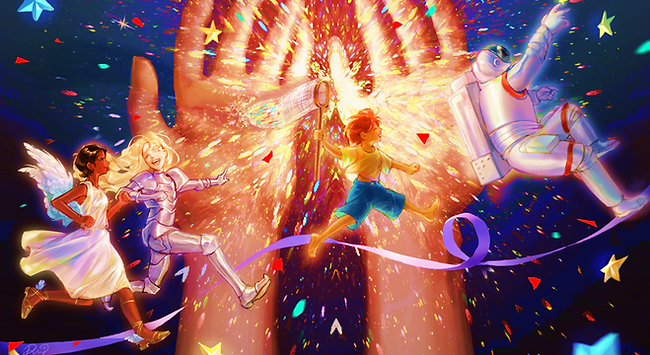
Peering down the lens of a kaleidoscope, a miniature universe springs to life. Flecks of colour tumble into place, fragments dance into intricate patterns, and ordinary little pieces present an image simultaneously complete, but ever-changing. Turn it ever so slightly, and the pieces rearrange themselves into something entirely new. The colours are the same, the pieces are unchanged, yet a new canvas unfolds. Science has a touch of this magic about it, too. Look a little closer, shift your perspective, turn a question on its head, and the familiar can become wonderfully strange.
What colour is a blueberry, really? How many hidden shades of colour might be disguised to the ordinary eyes? Why can an octopus transform its appearance in the blink of an eye, and what happens when we teach machines to create worlds of their own? Science invites us to peer beneath the surface of everyday wonders, revealing hidden structures, surprising mechanisms, and whole dimensions of reality that we might otherwise overlook. Sometimes, the world is far stranger than it first appears.
The magic doesn’t stop at what we can see. A geneticist might trace the tiny variations in our DNA that shape who we are, while an ecologist untangles the intricate threads linking individual organisms to entire ecosystems. From the microscopic machinery of proteins, to the vast expanse of space, each scientific lens brings a different part of the picture into focus. A question that seems to belong to one discipline might find its answer in another; an idea borrowed from nature might inspire a new technology; a shift in perspective might challenge everything we thought we knew. Like the fragments inside a kaleidoscope, these seemingly disparate pieces can come together in unexpected and beautiful ways.
Of course, no two people peer through the same lens. Our experiences, backgrounds, and curiosities shape the questions we ask and the details we notice. Even something as universal as colour can look entirely different depending on who – or what – is doing the looking. The picture becomes richer not because every fragment is identical, but because each brings something distinct to the whole. Perspective, it would seem, is often what we need.
For Issue 11, we invite you to explore Kaleidoscope in all its colours, contradictions, and possibilities. Science does not live in the black and white, but the kaleidoscopic complexity of colour, light and dark. The scientific study of our world requires curiosity and a willingness to uncover new patterns and discoveries; to consider how different pieces of a puzzle could fit together. As these latest articles probe from the furthest corners of Antarctica, to creatures of the sea and the biological underpinnings of who we are as humans, new lenses are applied to understanding the scientific mosaic of our world. Each offers another glimpse through the kaleidoscope, another chance to see something familiar anew.
So, take a closer look. Follow a curious question, embrace the unexpected, and don’t be afraid to give the kaleidoscope another turn. You never know what might come into view.
A word from the Cover Illustrator, Anrui Sun
The kaleidoscope was invented to share a perpetually dynamic vision of beauty, and while I designed this cover, I found myself inspired by my childhood memories of this instrument and its construction.
As a child peering into this toy, I thought of it as a portable galaxy; its colours flitted and fluttered between fleeting shapes and forms in the way I believed stars would. The image of each moment, different from the last and irrevocably reborn into new forms, was often the object of my curiosity and adoration.
In many ways, I believe the mutability of science– its ever-changing paradigms and theories–is similar to the kaleidoscope. Like science, where numerous components of evidence and theory are combined, the kaleidoscope holds many individual pieces, that when examined together, delights and fascinates us.
I hope to show this through the astronaut, who is the universe made sentient, and who sailed the stars to expand human knowledge. The child represents the wonder and awe we had for the world as children, which persists through our curiosity as pursuers of science. Finally, the angel and knight are reminders that though each of us are on our own quests for discovery, fortune, love, or fame, we should not forget to look around us, for there is much splendour and joy to be experienced along the path.


Back to
Issue 11
