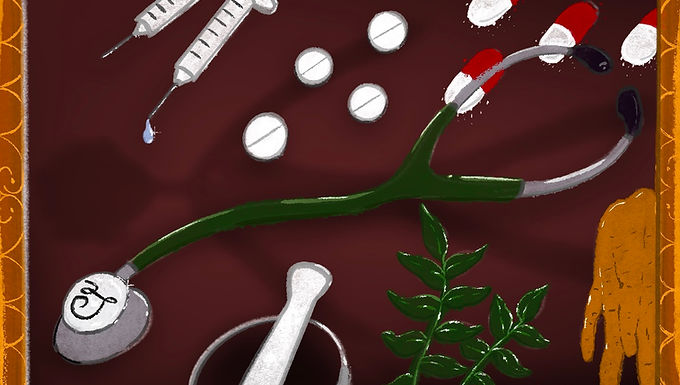
The only nourishment humans hunger for more than food is truth. For millennia, we have been propelled by this inarticulable appetite for discovery, yet our understanding of the human body has remained limited–and at times, conflicting. Our fascination with ourselves began long before the modern day. Prior to the interconnectedness of the contemporary global platform, research into the human body was undertaken independently in various cultures. As a result of geographical separation, cultures have arrived at different interpretations of our bodies, diseases, and treatments (1). The Chinese developed Traditional Chinese Medicine; from the Indian subcontinent arose Ayurveda; the Greek laid the basis for Unani. More recently, the Europeans gave us naturopathy, homeopathy, and of course–Western medicine. The modern Australian medical system is predominantly founded on conventional Western medicine. Nevertheless, traces of foreign medical practices have embedded themselves into the system (2). In a world now riddled with cultural intersections, the frontiers of knowledge and established practices collide, leaving us – as patients – with a critical question: who is right, and who is wrong? More interestingly, could both sides of the argument be right?
The vast backdrop of conventional Western medicine has certainly served us well. Western scientists have – for the most part – established a reliable theoretical basis upon which our understanding of bodily functions, diseases and treatments are founded (3). Through various experiments, they have visualised the microscopic and characterised the medically novel, revealing previously undiscovered cellular and molecular mechanisms, ultimately birthing the biomedical foundations of Western medicine (3). Discoveries such as William Harvey’s elaboration of the circulatory system in 1628, Edward Jenner’s founding principles of vaccination in the 1700s, and Louis Pasteur’s discovery of microbial origins in the 1800s are episodes in a lengthy collection that forms the foundation for Western medicine (3). Whilst there are still gaps in the Western understanding of bodies, studies such as these largely suggest that the foundations for Western medicine are tangibly sound - rendering them reliable to an extent.
The strength of Western medicine lies in the tangibility of the proposed cellular mechanisms. Alternative approaches such as Traditional Chinese Medicine and Ayurveda places greater emphasis on spirituality in body systems, undertaking the belief that intangible forces are at play to influence the human condition (3). Due to their immaterial nature, scientific inquiry is largely unable to support or refute these spiritual ideas. Although, interestingly – treatments based on these foundations aren’t completely unfounded.
For example, the concept of Qi (pronounced chee) is central to Traditional Chinese Medicine. Qi is thought to be a fundamental life force that circulates around the body, and it is believed that acupuncture can stimulate this circulation to relieve pain (1, 4). Sounds insane right? How can we manipulate an immaterial force to alleviate physical symptoms? It turns out that it may not be the immaterial Qi the acupuncture needle targets – but rather the fascia of musculoskeletal systems that cause the nerve stimulation experienced in acupuncture (5). Remarkably, acupuncture has been shown to reduce multiple types of pain in patients (4). The fascination here lies neither in the tangibility of Western mechanisms nor the grandeur of Chinese spirituality alone, but in how the two systems converge. The treatment stems from ancient China, but its mechanisms are more clearly elucidated by Western medicine. This harmonious combination of varying cultural understanding is fascinating. Better yet, it achieves the ultimate goal of treatments – to deliver a beneficial outcome to the patient.
The interplay of medical systems extends beyond just China and the West. For instance, yoga – widely prevalent in Ayurveda – is traditionally grounded in the Ayurvedic ideas of the three energies (called doshas) and the five elements in the human body, a foundation that may seem outdated. However, the practice of Yoga remains highly effective and complements many Western medical treatments (1). Additionally, it has been shown to improve outcomes of chronic conditions and pain (6). These positive outcomes for patients bode well with the Western understanding of pain sensation pathways (7).
The human body seems endlessly complex and rightly so. Medicine has been and will likely always be a developing field of intersecting understanding. By virtue of their persistence throughout centuries and even millennia, the medical systems from various cultures merit exploration and investigation. Whilst it is imprudent to single out a medical system as the best, it is prudent to cherish how differing approaches can complement each other to deliver benefits to patients. Validity and truth should not be overly emphasised when the goal of medicine is to do the greatest good for the greatest number of people. Through cooperation and unity, each system contributes to a more complete understanding of health.
References
Baars EW, Hamre HJ. Whole Medical Systems versus the System of Conventional Biomedicine: A Critical, Narrative Review of Similarities, Differences, and Factors That Promote the Integration Process. Evid Based Complement Alternat Med. 2017;2017:4904930. doi:10.1155/2017/4904930 PubMed PMID: 28785290; PubMed Central PMCID: PMC5530407.
Australian Health Practitioner Regulation Agency. AHPRA Annual Report 2023-24 [Internet]. Australian Health Practitioner Regulation Agency; [cited 2026 May 10]. Available from: https://www.ahpra.gov.au/Publications/Annual-reports/Annual-report-2024/Highlights.aspx
Silvano G. A brief history of Western medicine. Journal of Traditional Chinese Medical Sciences. 2021 Nov 1;8:S10–6. doi:10.1016/j.jtcms.2020.06.002
Vickers AJ, Linde K. Acupuncture for chronic pain. JAMA. 2014 Mar 5;311(9):955–6. doi:10.1001/jama.2013.285478 PubMed PMID: 24595780; PubMed Central PMCID: PMC4036643.
Finando S, Finando D. Qi, acupuncture, and the fascia: a reconsideration of the fundamental principles of acupuncture. J Altern Complement Med. 2012 Sep;18(9):880–6. doi:10.1089/acm.2011.0599 PubMed PMID: 22874011.
Holtzman S, Beggs RT. Yoga for chronic low back pain: A meta-analysis of randomized controlled trials. Pain Res Manag. 2013;18(5):267–72. doi:10.1155/2013/105919 PubMed PMID: 23894731; PubMed Central PMCID: PMC3805350.
Gupta S, Gautam S, Kumar U, Arora T, Dada R. Potential Role of Yoga Intervention in the Management of Chronic Non-malignant Pain. Evid Based Complement Alternat Med. 2022 May 28;2022:5448671. doi:10.1155/2022/5448671 PubMed PMID: 35668780; PubMed Central PMCID: PMC9167073.
